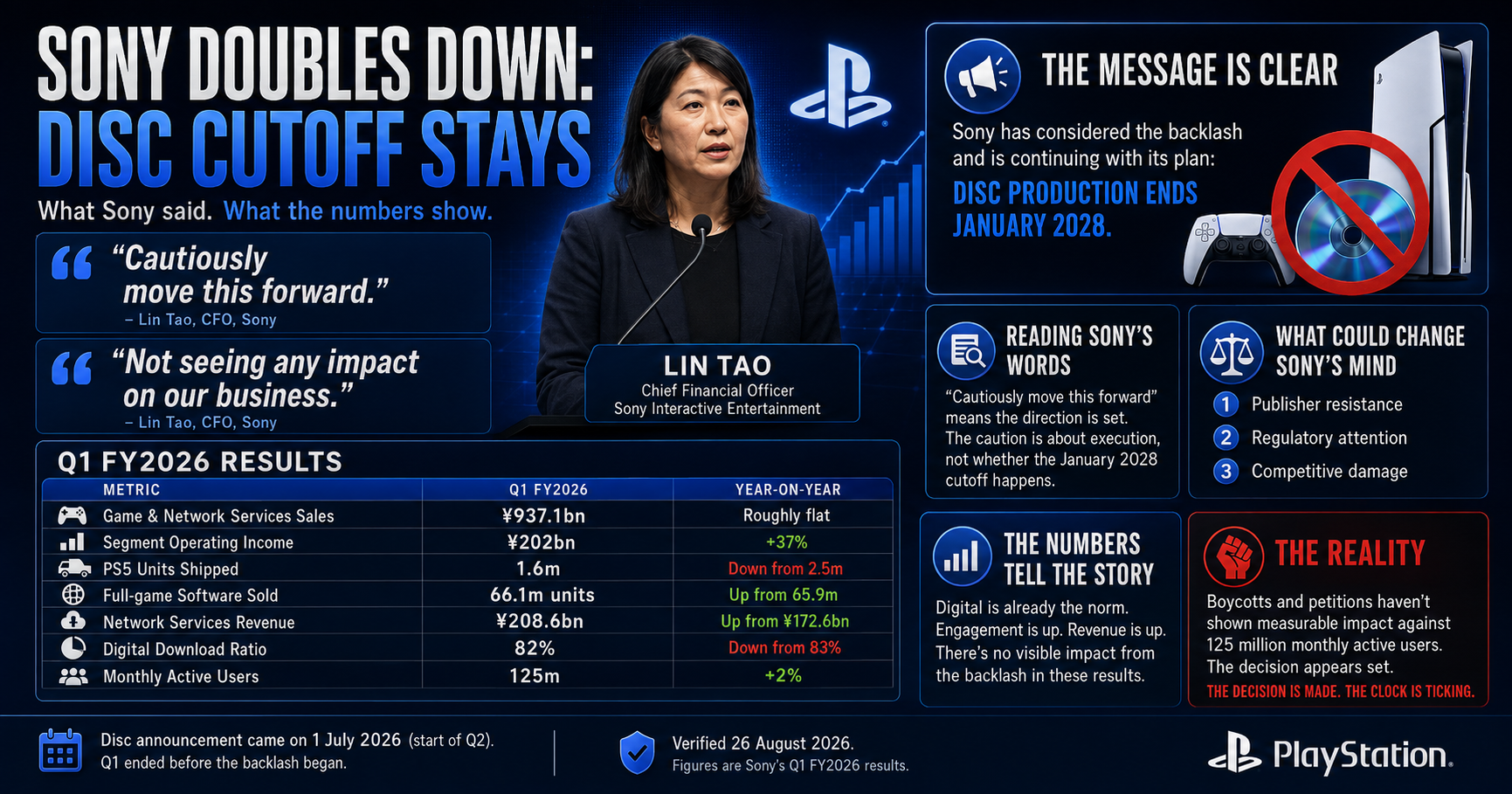
Anyone hoping the disc backlash would produce a climbdown should read Sony's own words on the subject, because they are unambiguous.
Speaking on the company's Q1 FY2026 earnings call, Chief Financial Officer Lin Tao addressed the controversy directly. Sony would, she told analysts, "cautiously move this forward." The company had weighed the decision carefully. The shift reflects a broader industry movement toward digital.
And the line that lands hardest with anyone currently boycotting: Sony is "not seeing any impact on our business."
Reading it properly
"Cautiously move this forward" is corporate phrasing that rewards a close read. It is not "we are reconsidering". It is not "we are listening to feedback". It is forward, with a modifier attached to the pace rather than the direction.
The caution is almost certainly about execution — retailer relationships, regional markets where physical remains disproportionately important, publisher partners who have their own physical strategies. It is not about whether the January 2028 cutoff happens.
The "no impact" line is the more interesting one, because it is simultaneously true and slightly beside the point.
The numbers behind the claim
Sony's Q1 FY2026 results give the statement its foundation:
| Metric | Q1 FY2026 | Year-on-year |
|---|---|---|
| Game & Network Services sales | ¥937.1bn | roughly flat |
| Segment operating income | ¥202bn | +37% |
| PS5 units shipped | 1.6m | down from 2.5m |
| PS5 lifetime (sell-in) | ~95.3m | — |
| Full-game software sold | 66.1m units | up from 65.9m |
| Network Services revenue | ¥208.6bn | up from ¥172.6bn |
| Digital download ratio | 82% | down from 83% |
| Monthly active users | 125m (June record) | +2% |
Read that table as Sony reads it and the disc decision looks obvious. Network Services revenue is up sharply. Software units held steady. Engagement hit a record. Four in five games sold are already digital. There is no line in that table where the backlash appears.
Read it as a sceptic and two things stand out. The disc announcement came on 1 July — the first day of Q2 — so Q1 could not possibly show an effect from it, and the "no impact" claim is describing a period that ended before the controversy began. And hardware shipments fell 36% year on year, which Sony attributes to normal late-cycle decline, but which does not make the number look better.
The first genuine test is Q2, and even then attributing any movement to a boycott rather than to seasonality or a thin release slate will be close to impossible.
What would actually change Sony's mind
Not petitions, and — on the evidence so far — not the #PSBlackout boycott either, which has produced no published data showing measurable impact against a 125-million-user base.
Realistically, three things could:
- Publisher resistance. Sony sets the manufacturing policy, but publishers with real physical businesses have leverage, and collector's editions are a meaningful revenue line for some of them.
- Regulatory attention. Digital ownership and consumer rights are live regulatory topics in the EU, and a market where the only purchase option is a revocable licence invites scrutiny.
- Competitive damage. Which is where Xbox's Disc to Digital programme becomes more significant than any hashtag — it establishes that a different approach was available.
The reasonable conclusion
Sony has heard the objection, considered it, and decided the economics point the other way. That is a company acting rationally in its own interest, and it is entitled to.
It is also, if you value ownership, a decision that makes your position permanently worse and about which you have essentially no leverage. Both of those can be true at once, and pretending otherwise in either direction is not useful.
Full background is in our explainer on the 2028 cutoff, and the practical implications are in what it means for your PS5.
Verified 26 August 2026. Figures are Sony's Q1 FY2026 results.
Discussion
Sign in to comment with your PSN.GG identity.
Be the first member to comment on this story.