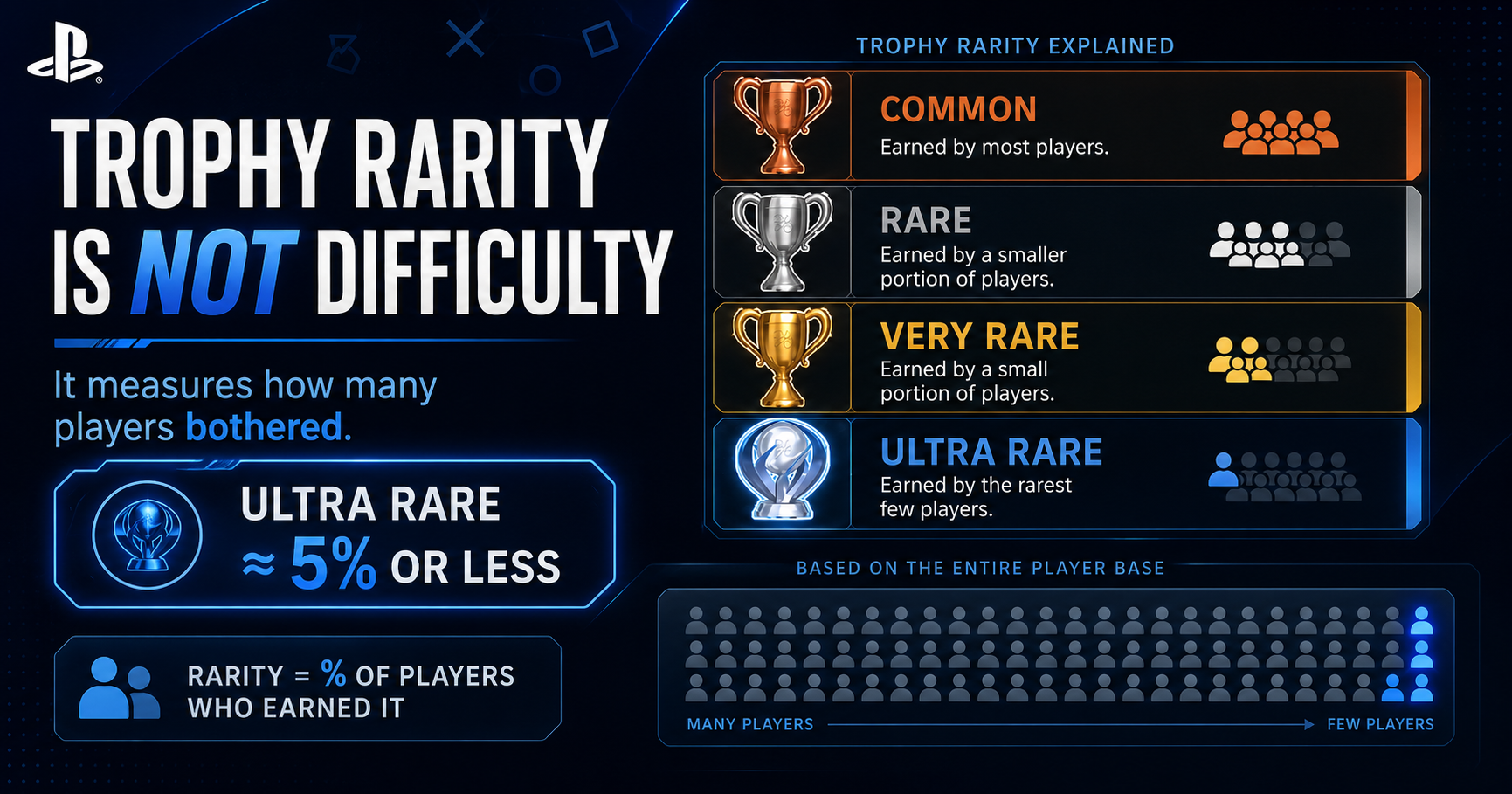
Trophy rarity is the most misread number in trophy hunting. An Ultra Rare badge looks like a difficulty rating, so people treat it as one — and then cannot understand why a trophy for finishing chapter two is rarer than one for beating the final boss on hard.
Rarity does not measure difficulty. It measures how many people bothered.
The tiers Sony actually uses
PlayStation sorts every trophy into one of four bands based on the percentage of players who have earned it:
- Ultra Rare — around 5% of players or fewer
- Very Rare
- Rare
- Common
And here is the part almost nobody says out loud: Sony does not publish the cutoffs. PlayStation's own support documentation confirms the four tiers and states only that the rarity level depends on how many players have earned the trophy. It gives no percentages. The single figure that is consistently observed and broadly agreed on is Ultra Rare sitting at roughly 5% or below.
So if you have seen a tidy five-tier table — Ultra Rare, Very Rare, Rare, Uncommon, Common, each with an exact boundary to two decimal places — that is a tracking site's own scheme, not PlayStation's. Trackers add finer bands because they are useful for sorting, and there is nothing wrong with them. They are simply not what your console displays, and quoting them as official is how a lot of misinformation spreads.
Ultra Rare is also a very wide band. A trophy earned by 4.9% of players and one earned by 0.02% wear the same badge despite being separated by a factor of more than two hundred. Anyone who cares about genuine scarcity reads the raw percentage, not the label.
The denominator is the whole story
Here is the mechanic that explains nearly every confusing rarity number: the percentage is calculated against everyone who has the trophy list registered to their account — not everyone who finished the game, and not everyone who played it seriously.
The moment you launch a game for the first time, you enter the denominator. If you play for ten minutes and never return, you stay in the denominator forever, dragging every trophy's percentage down.
The consequences are counterintuitive:
- Free and subscription games have brutally low rarity across the board. When a game is given away, millions of accounts add the list and a large share never launch it twice. Trophies that would sit at 40% in a paid release land in Very Rare territory.
- The first story trophy is a bounce-rate meter. If "complete the prologue" sits at 62%, then nearly four in ten people who own that game never finished the opening.
- Difficulty trophies on beloved games can be surprisingly common. A game people actually finish produces a completion curve that stays high all the way down the list.
Why the same trophy shows different rarity on different sites
You will regularly see a trophy listed as 1.2% on your console and 4.8% on a tracking site — or the reverse. Neither is wrong; they are answering different questions.
PSN's own figure is calculated against all PSN accounts holding that trophy list. Third-party trackers calculate against their own registered userbase, which is self-selected: people who sign up to a trophy site are, almost by definition, more likely to complete games. That population finishes more, so trophies look more common there.
Neither number is the "true" one. Just know which population you are reading before you brag about a percentage.
Rarity and difficulty do sometimes agree
None of this means rarity is useless. On a paid, single-platform game with an engaged audience, low rarity genuinely does track difficulty, because the denominator is mostly people who tried in earnest. The signal is strongest in these cases:
- A trophy far rarer than the one immediately before it in the list — that gap is where players quit.
- A platinum with a much lower percentage than the game's other gold trophies — the grind or skill wall sits somewhere in the remainder.
- Trophies for a specific difficulty setting, a no-death run, or an online mode with dead servers.
That last category deserves its own warning. Trophies tied to online multiplayer become effectively impossible once servers close, and their rarity freezes wherever it stood. An unobtainable trophy will happily wear an Ultra Rare badge forever, which does not make it an achievement — it makes it a locked door. Check whether a game's online component is still alive before committing to its platinum.
Using rarity to pick your next game
Rarity is at its most useful comparatively rather than absolutely. Two habits pay off:
Compare the platinum's rarity to the first story trophy. That ratio tells you what share of people who actually started the game went on to finish it. A platinum at 20% against a first trophy at 80% is a game people enjoy enough to complete. A platinum at 0.4% against a first trophy at 75% has a wall in it.
Read the list, not the badge. Sort a game's trophies by rarity and look for the cliff. Everything before it is routine. The cliff is the trophy that will decide whether you finish.
You can browse rarity data per title on our games database, and see how your own collection stacks up on the leaderboards.
Frequently asked questions
Does earning an Ultra Rare trophy give more XP?
No. XP depends only on the trophy tier — bronze, silver, gold or platinum. Rarity has no effect on levelling. The full numbers are in our trophy level XP breakdown.
Can a trophy's rarity change after I earn it?
Yes, constantly. Rarity is recalculated as more players add the list. A trophy that was Ultra Rare at launch often drifts into Very Rare after a sale or a subscription giveaway, and trophies in older games slowly get rarer as new owners stop appearing.
What is the rarest possible trophy?
Percentages round down, so trophies earned by a genuine handful of people display as 0.00%. These are usually tied to closed servers, region-locked releases, launch-window bugs, or events that ran once and will never run again.
Does rarity differ between the PS4 and PS5 version of a game?
Almost always, yes — they are usually separate trophy lists with separate player populations. The same trophy can be Common on one and Very Rare on the other.
Discussion
Sign in to comment with your PSN.GG identity.
Be the first member to comment on this story.